THE BUILDING PRODUCT E-BULLETIN
THE BUILDING PRODUCT E-BULLETIN
06 August 2026
The Future Homes Standard (FHS) is set to transform the way new homes are designed, built, and heated. With a clear focus on reducing carbon emissions and improving energy efficiency, the direction of travel for housebuilders and developers is now firmly established. However, achieving compliance is not simply a question of replacing gas boilers with heat pumps.
For specifiers, the challenge extends beyond meeting compliance targets on paper. The homes being designed today must demonstrate real-world performance, balance energy efficiency, occupant comfort, and long-term operational outcomes. Achieving this requires a whole-system approach that considers how heating, ventilation, and control strategies interact from the earliest stages of design.
Looking beyond the heat pump
Heat pumps are expected to become a cornerstone of FHS-compliant developments, with targets set to reach 600,000 installations per year by 2028. As these systems become more common, the focus is shifting toward the wider heating strategy and the importance of specifying heat emitters that can operate efficiently at low flow temperatures.
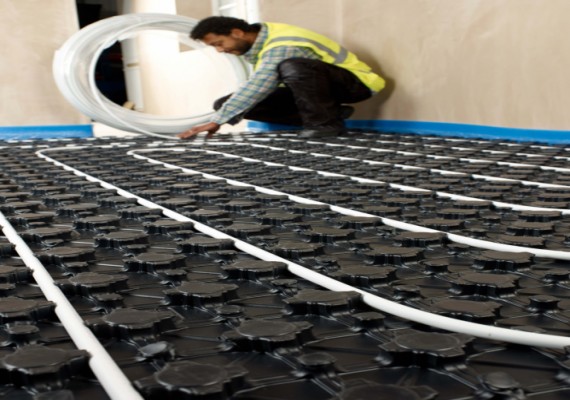
This is where underfloor heating (UFH) is increasingly proving its value. UFH is designed to deliver even heat distribution across the entire floor surface. The system operates at significantly lower temperatures – typically between 30-50°C for hydronic underfloor systems, like Wavin’s Comfia system, as opposed to the 60-70°C required for conventional radiators.
In homes therefore designed around heat pumps, specifying UFH is not just compatible – it is often fundamental to achieving the performance targets set out in the FHS. However, rather than acting as a standalone product choice, UFH should be viewed as part of a wider low-temperature heating strategy that supports the efficient operation of heat pumps and helps developments achieve the performance standards expected under the FHS.
A whole-home approach
The FHS doesn’t stop at how homes are heated. It also brings renewed attention to how they are ventilated.
As homes become increasingly airtight, ventilation strategies are becoming equally important in supporting indoor comfort and regulatory compliance. Mechanical Ventilation with Heat Recovery (MVHR) are becoming far more commonplace in new developments. By recovering heat from extracted air, these systems help maintain indoor air quality while supporting energy efficiency targets.
Equally important is ensuring that heating, ventilation and control strategies are considered collectively during specification. While each system may perform effectively in isolation, the greatest gains are achieved when they are designed to operate as part of a coordinated indoor climate strategy. Systems such as Wavin Sentio provide precise, room-by-room control through an intelligent central unit which are compatible with manufacturers full suite of indoor climate products. Technologies like these can help optimise energy use, improve occupant comfort and ensure buildings perform as intended throughout their lifecycle.
Specifying homes for the future
As the FHS draws closer, successful specifications will increasingly be judged on how effectively they integrate low-carbon technologies rather than simply selecting them.
For specifiers, this means looking beyond standalone technologies and considering how heating, ventilation and controls interact as part of a complete indoor climate strategy. By taking a whole-system approach from the outset, projects can be better positioned to meet evolving regulatory requirements while delivering comfortable, efficient, and future-ready homes.
To learn more about Wavin’s indoor climate solutions, visit: https://wavin.com/gb/solutions/indoor-climate-solu...
View Previous Article
Right System, Right Setting: Applying Electric Heating in Modern Buildings

TSP Media
Grosvenor House
Central Park
Telford
TF2 9TW